Bio
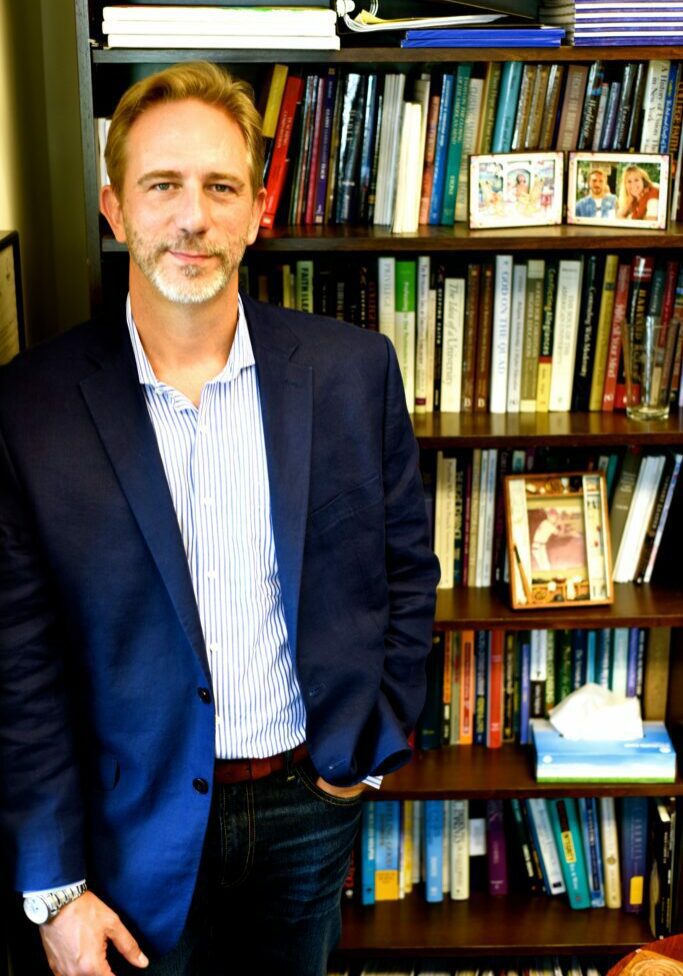
David Gushee brings sustained reflection on scripture, ethics, the church, and public life, writing as a Christian ethicist from a post-evangelical perspective.
Rev. Dr. Prof. David P. Gushee earned his Ph.D. in Christian ethics from Union Theological Seminary (NY). Now in his fourth decade of teaching, he has served as Distinguished University Professor of Christian Ethics at Mercer University since 2007. He is also Chair of Christian Social Ethics at Vrije Universiteit (Free University) and Senior Research Fellow at its partner school, International Baptist Theological Study Centre. Through these Amsterdam-based institutions he is privileged to supervise Ph.D. students from around the world.
Gushee is the elected past-president of the American Academy of Religion and the Society of Christian Ethics. As of 2025 he is the author, co-author, editor, or co-editor of 30 books, including the bestsellers Kingdom Ethics and Changing Our Mind. His other most notable works are Defending Democracy from Its Christian Enemies, After Evangelicalism, and most recently, The Moral Teachings of Jesus. He lectures and consults globally, regularly speaking to the press and on podcasts as well as in academic and ecumenical church settings. He is widely regarded as one of his generation’s most significant Christian moral thinkers.
Over a full 30-year career, he’s been a devoted teacher and mentor as Professor Gushee to college students, seminarians, and PhD students. He’s also led activist efforts on climate, torture, and LGBTQ inclusion, and continues to be a keynote speaker at churches, forums, and universities.
For the general media, Gushee has written hundreds of opinion pieces and given interviews to scores of major outlets and podcasts.
Prof. Gushee and his wife, Jeanie, live in Atlanta, Georgia and Chipping Campden, England. They are the parents of three adult children and grandparents of three little ones.
David's Story
I grew up in Vienna, Virginia, a lovely little town just outside Washington, DC. My father worked for the Congressional Research Service doing policy analysis. My mother mainly raised us four rowdy kids and tried to wrangle us to St. Mark’s Catholic Church. I was the oldest and was not much help.
By the age of 15 I was on a spiritual search. It took me into a Southern Baptist church one sunny summer weekend in 1978. Four days later I was a born-again convert. Two weeks after that I was baptized by full immersion. My personal Christian journey had begun.
Being a new believer did not solve all my problems. But it did clarify my identity, give me deep meaning, and provided a path to a profession. I was going to be a pastor. That was clear to me by the time I turned 17, and it never really went away.
My college years at William & Mary was a make or break time for my naïve early version of Christianity. But the clash between SBC faith and religion department doubt was mediated through Baptist Student Union community, which is one reason why I think it’s quite a shame that Baptists seem to have largely abandoned college ministry.
Off to Southern Baptist Theological Seminary. Youth ministry. Awful. Peacemaking work. Cool. Discovery of the thrill of high-end academic study of religion. By my third year, I knew that I wasn’t done with school and that my next step must be to get out of the South and go get a PhD in Christian Ethics. Why ethics? Because it is where faith meets the problems of the world. With my pregnant wife Jeanie, we moved to Manhattan and Union Seminary.
Six years later in 1993, I was Rev. Dr. Gushee. Twenty-eight years of teaching, writing, and advocacy have followed.
I have never regretted or even doubted my calling – I followed Jesus into conversion, ministry and preaching, academia, and the various studies and battles ever since. I still love ethics, the discipline that helps Christians think about how their faith applies in personal and social life. But I do have the scars to show for it, because these days people are far more likely to get REALLY ANGRY over ethical differences than theological ones. My battles have included issues like climate change, torture, LGBTQ inclusion, and white supremacism. Fun times.
Most days my work is typical academic stuff: prep lectures, teach classes, grade papers, write essays. Some days it is a lot hotter than that. That’s okay. I can rest when I retire. If I do.